Marta Pavelka
My research lies in geometric and topological combinatorics. I am a postdoctoral researcher in the QMATH group at the University of Copenhagen.
I study simplicial complexes, polytopes, and triangulated manifolds. A central theme of my work is extending graph-theoretic structures, such as Hamiltonicity, interval structures, chordality, and Kneser graphs, to higher dimensions.
I also investigate structural, enumerative, and extremal questions for triangulated manifolds, together with connections to shellability, Alexander duality, and commutative algebra.
Previously, I was a postdoctoral researcher at Carnegie Mellon University. I received my Ph.D. in Mathematics from the University of Miami in 2023 under the supervision of Bruno Benedetti.

Research
Higher-dimensional graph theory
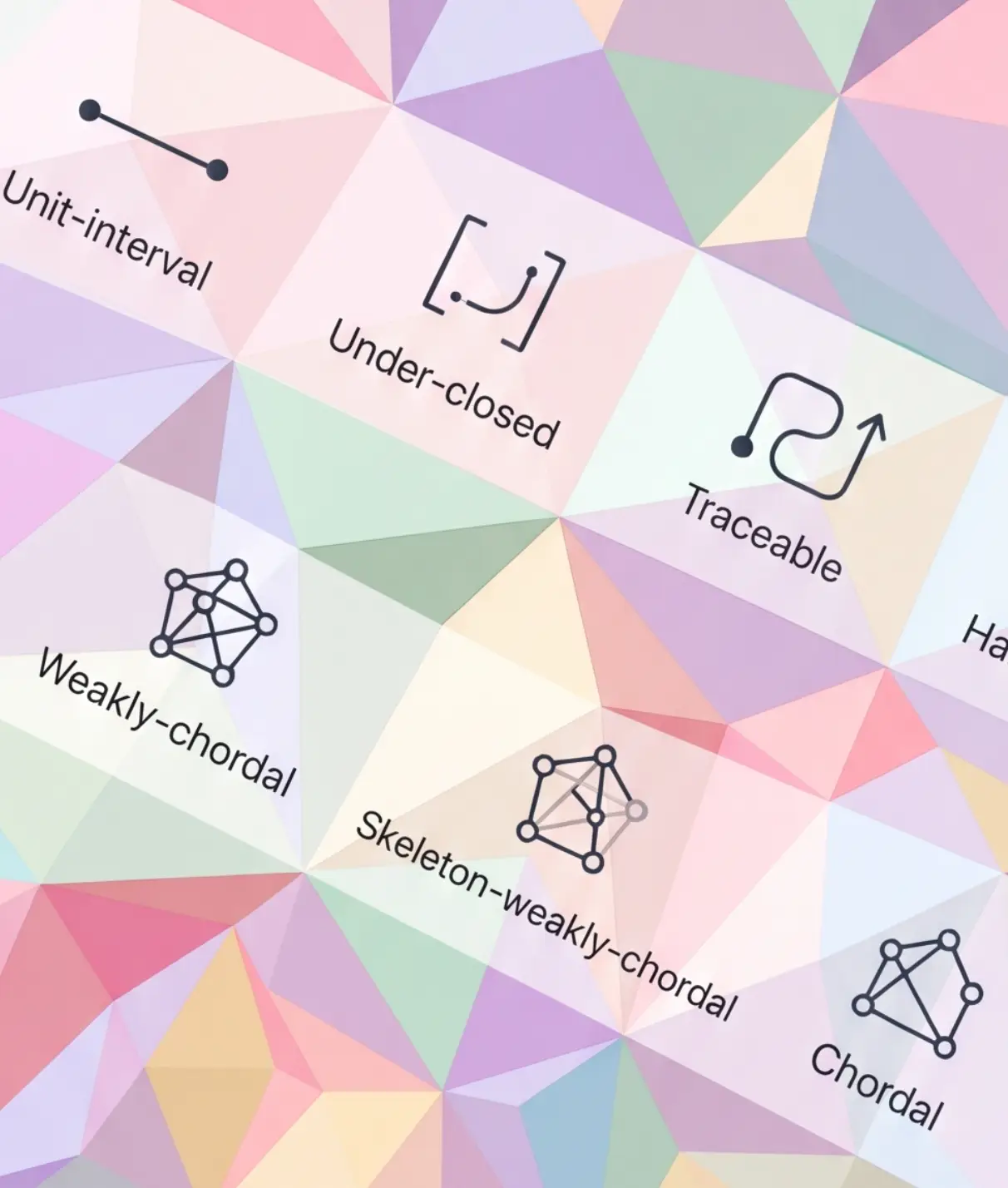
I study extensions of graph-theoretic properties, including chordality, Hamiltonicity, interval structures, and Kneser graphs, to simplicial complexes and polytopes.
Triangulated manifolds
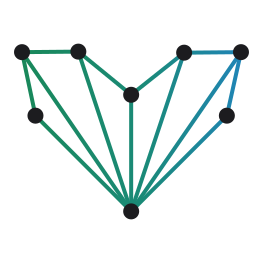
I investigate structural and extremal questions for triangulated manifolds, including enumeration, dual graphs, reduced balls, and efficient triangulations.
Combinatorial topology and algebra
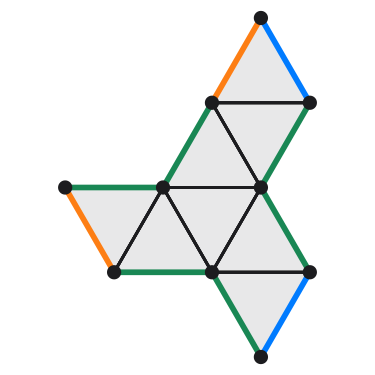
I study how combinatorial properties of simplicial complexes interact with shellability, vertex decomposability, Alexander duality, and commutative algebra.
Current projects
Reduced balls and dual graphs
With Bergfinnur Durhuus, I study structural properties of reduced triangulated balls and their dual graphs. This project is motivated by the problem of estimating the number of triangulated 3-spheres with a given number of tetrahedra.
Higher-dimensional chordality
With Bruno Benedetti, I study extensions of chordal graph theory to simplicial complexes. We seek higher dimensional analogues of several classical characterizations of chordal graphs, with particular emphasis on properties that are structurally meaningful and efficiently testable. The first part of this project is available on arXiv, while the second is in progress.
Kneser graphs of polytopes
With Florian Frick, I study Kneser graphs associated with polytopes and the relationship between their geometric structure and edge-criticality and vertex-criticality.
Cubical complexes and efficient triangulations
With Hailun Zheng, I study cubical complexes and small triangulations of manifolds satisfying desirable combinatorial and topological properties.
Publications
Skeleton Chordalities
with Bruno Benedetti, 2026
Introduces and compares higher-dimensional notions of chordality and relates them to simplicial vertices, decompositions, vertex decomposability, and Alexander duality.
Chordality, syzygies, and shellability for hypergraphic analogues of interval graphs
with Anton Dochtermann and Bennet Goeckner, 2026
Identifies underclosed complexes with complements of cointerval hypergraphs and connects them to chordality, shellability, vertex decomposability, and linear quotients.
Vertex orders in higher dimensions
with Bennet Goeckner, 2025
Studies higher-dimensional analogues of interval graphs and structural properties arising from vertex orders.
A conditional lower bound for the Turán number of spheres
with Andrew Newman · Combinatorics, Probability and Computing 34, no. 6, 848–856, 2024
Studies extremal questions for triangulated spheres and gives lower bounds for their Turán numbers.
Higher-dimensional counterexamples to Hamiltonicity
with Bruno Benedetti · Graphs and Combinatorics 42, no. 1, Article 14, 2023
Characterizes the dimensions in which every polytope graph is line-Hamiltonian, showing that dimension three is the unique exception.
2-LC triangulated manifolds are exponentially many
with Bruno Benedetti · Annales de l’Institut Henri Poincaré D 11, 363–382, 2022
Proves exponential bounds for a broad class of triangulated manifolds defined through local constructibility.
On-line algorithms for multiplication and division in real and complex numeration systems
with Christiane Frougny, Edita Pelantová, and Milena Svobodová · Discrete Mathematics and Theoretical Computer Science 21, no. 3, 2019
Develops online algorithms for arithmetic in real and complex numeration systems.
Teaching and mentoring
Teaching Excellence Award, University of Miami, Math Department (2022)
Teaching mathematics is, in some ways, like teaching yoga: progress comes through regular practice, clear guidance, gradual development, and challenges matched to the student’s level.
Project Mentor at the University of Copenhagen

I lead a course in which first-year bachelor’s students work in small groups on their first mathematical projects and produce a written manuscript. I taught the course in Spring 2026 and will teach it again in 2027.
Instructor at Carnegie Mellon University

I taught Integration and Approximation to approximately 80 students per section in Fall 2023, Spring 2024, and two sections in Spring 2025. Each semester, I also coordinated a team of three to six teaching assistants.
Instructor at the University of Miami

Between Fall 2020 and Spring 2022, I taught several undergraduate courses, including Precalculus II, Calculus I, and Calculus II, with approximately 40 students per section. My responsibilities included both lectures and recitations.
Recitation Instructor at the University of Miami and Czech Technical University

Between Fall 2016 and Spring 2020, I led recitations for undergraduate courses including Calculus II, Calculus I, Precalculus II, and Foundations of Mathematical Analysis.
Service to community
Selected talks
Selected invited, seminar, and conference talks across the main areas of my research. A complete list of talks is available in my CV.
ColloquiumUniversity of HawaiiNovember 2024
Talk on Vertex orders: From graphs to complexes